Pogues article in the Boston Globe
http://www.boston.com/ae/music/
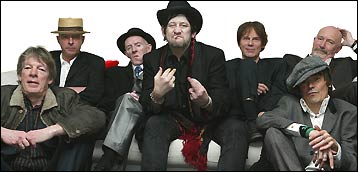
Survivors
After years of very hard living, Shane MacGowan of the Pogues should really be dead. But he and the band are back, breathing life into their careers
with a long-awaited us tour.
By Joan Anderman, Globe Staff | March 5, 2006
DUBLIN -- When Shane MacGowan lurches into the Morrison hotel on a recent Thursday afternoon, clutching a cocktail, half the people in the lobby begin
to breathe again. The famously damaged frontman for the Irish folk-punk band the Pogues is usually late by several hours, but MacGowan was delayed
overnight by emergency surgery on an abscess under one of his few remaining, rotted teeth. In four hours he and the band are scheduled to arrive on
the red carpet at the Meteor Ireland Music Awards, this country's equivalent of the Grammys, where the Pogues will receive a Lifetime Achievement
Award.
Meanwhile, there is much pain-killing to do. Never mind the reporter and photographer who have been waiting for most of the afternoon. Surrounded by
several attendants, MacGowan -- bearded, portly, and ghostly pale -- executes a series of tiny, shuffling steps into the elevator and disappears.
Fame is the great enabler. It allows middle-age men to behave badly and still get paid. It arranges for rudeness to be greeted with an indulgent
smile. Lucidity is entirely optional. The alternative, after all, builds a better myth. MacGowan was the quintessential drunken poet: vicious and
gifted, belligerent and tender, a shambolic talent hell-bent on destroying itself.
''Egos exploded, so I started to implode mine by shattering it with drugs and drink," MacGowan says, in a barely comprehensible slur, later that
evening at the Point Theatre. ''I had plenty of money so I could expand my excesses beyond my wildest dreams."
By all accounts, including his own, MacGowan should be long gone. A Dublin taxi driver responded to news that the Pogues were in town with a
universally shared sentiment: ''Shane's still alive?"
That MacGowan is still standing, albeit not for long periods and not without help, is part of the reason the public is still fascinated with the
group, which has reconvened for a brief US tour -- the Pogues' first stateside shows since 1989. But the sheer unlikelihood of the band's existence 24
years into its pocked career isn't why the Pogues were honored at the Ireland Music Awards last month, nor does it account for the speed with which
their upcoming shows, including two in Boston on March 14 and 15, sold out. (The group will also play in Washington, D.C.; in Atlantic City; and four
nights in New York.)
SAMPLE SONGS BY THE POGUES
Listen to audio clips at www.boston.com/ae/music
For that one has to return to the Pogues' music: a riotous union of traditional Irish instrumentation and punk-rock intensity that blew in like a
raucous pub party in the middle of the synth-saturated '80s. To this day the members regret that their image as boozehounds belied, and continues to
distract from, the complex emotions and artistic rigor of the Pogues' literate balladry and howling, fife-fueled assaults.
But the fact remains that MacGowan's and the rest of the band's exuberantly wasted lifestyle was as integral to their spirit and their success as it
was to their downfall -- which is why the sight of guitarist Philip Chevron's gray suit and argyle tie, and the sound of his erudite analysis
delivered in a sleek conference room on the afternoon of the awards show, inspires a certain awe. Five other polite and put-together Pogues are
gathered around the table as well: tin whistle player Spider Stacy, drummer Andrew Ranken, bassist Darryl Hunt, guitarist-accordionist James Fearnley,
and banjo player Terry Woods.
Absent are multi-instrumentalist Jem Finer, now a highly regarded conceptual artist who is in London attending to a previous commitment, and MacGowan.
Shane will give the rambling, testy interview his manager has promised just prior to the awards show. He will insist that the reporter wear the
musician's dark glasses throughout. He will pepper his largely incoherent, occasionally illuminating comments with an astonishing emission that's been
aptly compared to an exploding coffee machine. It is, apparently, laughter.
''There was a time when we had been shunted into the sightings of history," says Stacy, the band diplomat, who functions as a sort of anti-Shane.
MacGowan insults the Dropkick Murphys; Stacy calls the next day to sing the Boston group's praises. His bandmates proclaim the utter irrelevance of
the Lifetime Achievement Award and Stacy pipes up with the corrective. ''Since we started doing these reunion tours [the Pogues have played Christmas
shows in the UK for the past several seasons], it seems we're getting wider recognition, a place in rock 'n' roll history, which I think we're
entitled to."
Like the Pixies, also college-rock cult heroes who today play for bigger audiences in bigger venues than they did in their '80s heyday, the Pogues are
riding a wave of nostalgia. But they're also discovering the enduring appeal of a great song -- a happy state of affairs, considering MacGowan hasn't
composed a new one in years.
''I've written quite a lot already," he snaps, ''and I quite prefer singing other people's songs, or old ones. Although if any old-fashioned record
company wants to give us a hundred grand to make a record we'll turn it in in a [expletive] day."
MacGowan, once a prolific tunesmith, is widely regarded as a songwriter's songwriter. Among the Pogues' early fans were Elvis Costello, who produced
the band's 1985 breakthrough, ''Rum Sodomy & the Lash," and Bob Dylan, who in 1988 invited the group to open a handful of shows on his tour. That same
year the Pogues released ''If I Should Fall From Grace With God" which featured their biggest hit: the fractured Christmas carol ''Fairytale of New
York," a lilting, bittersweet duet with the late Kirsty MacColl that sets the transience of love against the joys of the season.
''This material is never going to age," says Chevron, ''so as we get older we respond to the songs in different ways. For instance, 'The Old Main
Drag,' that was written from the point of view of a young guy about older people. He's projecting a possible future for himself. When Shane sings that
today, it has a whole new level of meaning. Honestly, part of the thing that's appealing about us is that we survived."
Indeed. Those prestigious Dylan dates? MacGowan missed them, and plenty of others during the years-long binge that preceded his dismissal from the
band in 1991 -- nearly a decade after meeting Stacy in a London tube station and forming (with Fearnley) the Pogue Mahone, Gaelic for ''kiss my arse."
The trio soon shortened its name to the Pogues and developed into a full band, with the addition of Finer, Ranken, Chevron, and bassist Cait O'Riordan
-- who left the band after three years to marry Costello. (The couple divorced in 2002.) Hunt replaced her, and Woods was soon added to the lineup.
In a bizarre twist that threatens to derail MacGowan's tenuous grasp of functionality at the awards show, O'Riordan is waiting when the band arrives
at the Point Theatre. She had joined the Pogues for their Christmas 2004 shows and was not, for personal reasons no one is eager to detail, invited
back. As the cameras flash, she saunters down the red carpet with her former bandmates, enters the building, and pleads with them to let her appear
onstage during the grand finale of the Meteor Awards.
Nearly an hour of tense, closed-door discussion with various configurations of band members and management follows. O'Riordan doesn't join the band
for its show-closing, show-stopping performance of ''The Irish Rover," but three members of the Dubliners do. MacGowan is a brilliant mess, tumbler of
booze sloshing everywhere, butting heads with the microphone and, amazingly, nailing every quicksilver verse. During his presentation of the award,
musician Gavin Friday, another maverick Irishman, calls MacGowan a beautiful soul and a rebel, a writer of songs that will outlive everyone in the
theater.
''The music's not original at all," protests MacGowan in the band's dressing room. His contrary nature has momentarily crushed his soft spot for
adulation. ''We're just doing what Los Lobos were doing with Tex-Mex. Mixing rock 'n' roll with Irish music. The press called it Leprechaun-o-billy.
Its official name is Paddy Beat. Right, yeah? You got all that?"
Whatever you want to call it, the Pogues caught on, becoming the politically charged voice of London's young Irish immigrants and, on a broader
canvas, angry, intelligent flag bearers for outsiders everywhere. The band grew stronger and tighter as the '80s wore on, even as a grueling touring
schedule and drug and alcohol abuse took their toll -- on MacGowan more than anyone.
''We had to develop strategies for when he didn't show up or didn't show up in a fit state to sing the songs," says Fearnley, who lives in Los Angeles
and recently became a US citizen. ''Spider took a lot of the singing, with help from Darryl, and Terry chipped in."
''One of the reasons, paradoxically, that we became a good band is we did have these coping strategies," says Hunt. ''There was a great occasion in
Australia when not only Shane departed the stage but Spider did as well, to puke into the river nearby."
Finally, in 1991, at a hotel in Tokyo, MacGowan's bandmates dismissed him. It was, all agree, rather more civilized than circumstances might suggest.
''We sat down with him and said, 'You don't look like you're having much fun with this anymore,' " Chevron recalls. '' 'It seems obvious you don't
want to continue, but as it turns out we do.' He said that was pretty much the story. And we all went out and had dinner."
The band forged ahead, with the Clash's Joe Strummer filling in on lead vocals before Stacy became the permanent singer. But over the next five years
Fearnley, Chevron, and Woods left the band, and in 1996 the Pogues called it quits. MacGowan, meanwhile, had formed the Popes, with whom he made
several albums during the '90s. When the Pogues' longtime accountant Anthony Addis, now the band's manager, floated the idea of a reunion in 2001, the
reaction was a bit of trepidation mixed with a heap of curiosity.
''Personally, I was disappointed that the Pogues fizzled out like a damp squib," says Woods. ''The band was bigger and better than that."
The reunion ''was meant to be a one-off," notes Chevron.
''From my point of view it was going to be the finale we deserved," says Stacy.
''Also, I have to say they did offer us a very fine fee," adds Hunt.
''But," Chevron says, ''we didn't know if it would be a new beginning or a last hurrah until we actually did it."
Half a decade later, they still don't know exactly what the future holds. Odds are good the Pogues won't record an album of new material, and with
wives and children in the equation, nobody is interested in extensive touring. These days Stacy, Woods, and Chevron are sober; Hunt, Fearnley, Ranken,
and Finer imbibe recreationally, and they all seem to be in agreement that being in this band is infinitely more enjoyable this time around.
As for the singer -- clean living isn't an option. ''I'm Irish!" he yells, and his old friends in the Pogues kick back on the dressing room sofa with
bottles of soda and practiced disinterest as Shane MacGowan, a senescent but still-powerful storm, happens around them.
If I fail math, there goes my chance at a good job and a happy life full of hard work.
|



![[*]](images/thorp/default_icon.gif)